For a long time, AI application development centered heavily on Prompt Engineering—crafting that single, flawless prompt to get high-quality text or code from an LLM in one shot.
However, as AI agents grow increasingly capable, Loop Engineering is rapidly replacing simple prompt optimization as the cornerstone methodology for building production AI applications.
The Paradigm Shift: From "Linear Q&A" to "Autonomous Loops"
Loop Engineering is not a specific tool; it is a systems design mindset tailored for AI agents. Its core premise is breaking away from the linear, one-and-done prompt-response pattern to establish an execution feedback loop with built-in self-correction capabilities:
Designing a dynamic mechanism of "Feedback, Evaluation, Correction, and Iteration" that keeps the AI running autonomously until the objective is met.
In traditional setups, the workflow was issue a prompt, receive an output. In Loop Engineering, the paradigm shifts to define an objective, monitor the process. The AI doesn't stop once content is generated; instead, it enters a self-driven iterative loop:
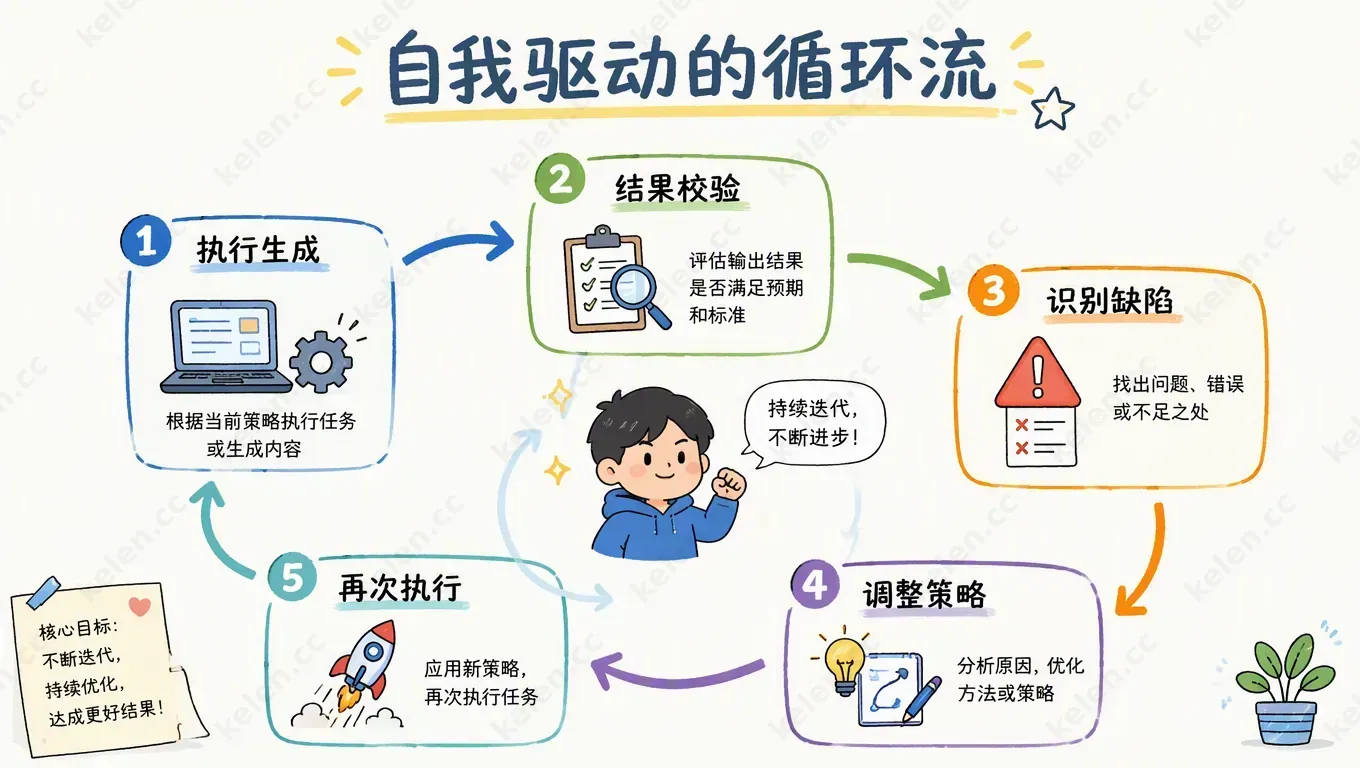
This pattern is already delivering real-world value across multiple domains:
- Intelligent Coding Assistants: Automatically run unit tests after generating code, capture error logs, refactor the code, and repeat until all tests pass green.
- Deep Research Tools: Gather information, evaluate the integrity of the evidence chain, and autonomously launch new rounds of retrieval and cross-validation upon discovering logical gaps until reaching a sound conclusion.
- Automated Marketing Agents: Draft copy, automatically audit it against brand guidelines and compliance rules, and iteratively rewrite until it fully satisfies publication standards.
Fundamentally, Loop Engineering transforms AI from a passive question-answerer into an accountable digital worker committed to end outcomes.
Loop Engineering vs. Prompt Engineering
While often conflated, they actually operate at fundamentally different layers of AI engineering:
| Dimension | Prompt Engineering | Loop Engineering |
|---|---|---|
| Core Focus | Optimizing single-turn interaction quality | Designing end-to-end execution logic |
| Interaction Pattern | Single request and response | Multi-turn, continuous iterative loops |
| AI Role | Passive content generator | Proactive problem solver |
| Use Cases | Creative writing, simple Q&A, translation | Complex task decomposition, automated ops, Agent systems |
| Fault Tolerance | Relies on manual prompt tweaking and retries | Automated evaluation, self-healing, and re-execution |
| Analogy | Asking the right question | Managing a project through to delivery |
Core Architecture
We all know that once an LLM finishes a turn, its context is wiped clean. Loop Engineering turns these stateless single interactions into stateful, self-healing, continuously evolving automation loops. Addy Osmani breaks this architecture down into six core components. Rather than a loose collection of tools, they form an integrated pipeline: Trigger → Isolation → Cognition → Execution → Delegation → Memory.
Automations
Automations act as the loop's triggers, scanning repositories, CI logs, and issue trackers on schedules to handle discovery and triage. For instance, Claude Code uses /loop for periodic execution and /goal to run continuously until termination criteria are met, while also supporting cron jobs, webhooks, and GitHub Actions.
Worktrees
Code conflicts are a major risk in parallel execution. Worktrees provide each Agent with an isolated Git working directory and branch, sharing the repository history without collisions. Claude Code achieves this exact isolation via git worktree, the --worktree flag, and sub-agent isolation: worktree configurations.
Skills
Agents start cold on every run. Skills codify project conventions, build steps, and historical lessons into reusable knowledge via SKILL.md. Claude Code leverages this same SKILL.md format and invocation pattern. Skills serve as the authoring format; when shared across repositories, they can be packaged and distributed as Plugins.
Plugins and Connectors
Connectors use the Model Context Protocol (MCP) to plug Agents into real-world tools—issue trackers, databases, staging APIs, and Slack—turning them from advisors into executors. Claude Code relies on MCP Servers, meaning the same Connector can seamlessly work across different tools. Plugins package Connectors and Skills together, enabling teams to install full toolkits with a single command.
Sub-agents
Decoupling the code-generating Agent from the code-reviewing Agent is a foundational pattern in Loop Engineering. Claude Code defines task-specific sub-agents under .claude/agents/ and supports Agent Teams passing work between members. A typical split includes an explorer, an implementer, and a validator checking against specs and tests. Claude Code's /goal under the hood similarly uses a distinct model to evaluate termination conditions—essentially a variant of this same design.
State
Because LLM context is completely lost between runs, loops must rely on external persistent storage to track progress and pending tasks. Claude Code utilizes AGENTS.md, progress log files, or Linear via MCP. Memory must live on disk rather than in context—agents forget, but repositories don't.
Together, these six components form a self-healing, auditable, and scalable automated engineering loop. This architecture is not exclusive to Claude Code; it is a reference blueprint for modern AI engineering that can be replicated in any Agent framework supporting MCP, Worktrees, and Skill definitions.
Conclusion
Prompt Engineering remains an essential foundational skill for human-AI interaction and isn't going away. But when it comes to building sophisticated, production-grade applications, Loop Engineering is unequivocally the path forward.