
On September 15, 2026, a San Francisco company called TypeSafe AI, freshly out of stealth, officially released Jev. That same day it hit 1679 points on Hacker News, was integrated into the Vercel AI Gateway the very next day, and OpenRouter quickly added it as well. Real-world testing posts from developers on X nearly flooded the timeline.
Many people feel confused the first time they hear "Jev": what exactly is it? Why did even the CEO personally post that "this might be the shortest path to a revolution in the AI economy"?
What Is Jev?
Jev is TypeSafe AI's first System One model.
The name has a twofold origin:
- In psychology, it corresponds to System One from Thinking, Fast and Slow (fast, intuitive judgment), while traditional LLMs are positioned as System Two (slow thinking, token-by-token reasoning).
- It also pays homage to the economist Jevons (the Jevons Paradox): once intelligence becomes cheap enough, use cases will explode in growth.
The core positioning in one sentence:
unstructured state in, typed probabilistic decisions out
It doesn't chat, doesn't write articles, doesn't generate code, and doesn't explain itself. You give it a piece of state (text, JSON, or arrays all work) plus a set of predefined questions, and it evaluates all the questions in parallel in a single pass, directly returning structured answers with calibrated probabilities.
Founder Diogo Almeida is a former OpenAI researcher and one of the key contributors to InstructGPT/RLHF. He stated bluntly in the launch post that super chat models over the past few years haven't delivered truly large-scale automation, because what software needs is "decisions," not "a readable passage of text."
The Three Primitives
Jev only answers three types of questions:
| Type | Purpose | Example Output |
|---|---|---|
| Choice | Pick one from predefined options | Selected result + probability distribution + confidence |
| Score | Score on an ordinal scale | Score + probability distribution + confidence |
| Noul | Yes/No judgment | Probability of true (0–1) |
All questions are computed in parallel within a single forward pass — there is no autoregressive generation process. Because of this, it cannot produce out-of-type hallucinations: the output is always exactly the structure you defined.
Core Advantages
The official numbers from specific workflow evaluations are quite aggressive:
- End-to-end latency: 70–500ms
- Up to 193.6x faster than frontier LLMs
- Up to 444.6x cheaper
- Pricing: $0.042 per million input tokens, output completely free
Since there is no token generation process, it is especially suited to scenarios that require high-frequency invocation (multiple decisions per second) — ridiculously fast, ridiculously cheap.
A Practical Code Example
Below is a complete example using the most common official Python SDK. You can follow along and try it hands-on.
Installation:
pip install typesafe-sdk# oruv add typesafe-sdkSet the environment variable:
export TYPESAFE_API_KEY="你的API_Key"Let's use a real-world scenario: customer support ticket auto-routing + urgency + sentiment scoring
from typesafe_sdk import Choice, Noul, Score, TypeSafeClient client = TypeSafeClient() # 默认使用 jev-latest ticket = """Hi, I've been trying to connect my Stripe account for 3 days and it keeps failing.I'm losing sales. Please help ASAP.""" response = client.system_one( state=ticket, questions={ "department": Choice( instructions="Which team should handle this request?", criteria={ "billing": "Payment, subscription, refund or invoicing issues", "technical": "Bugs, outages or integration problems", "sales": "Pricing, upgrades or account questions", }, ), "frustration": Score( instructions="How frustrated does the customer appear?", criteria=[ "Calm, just stating facts", "Frustrated but civil", "Very angry, strong language", ], ), "is_urgent": Noul( instructions="Does this message convey urgency or time-sensitivity?", ), },) # 直接拿到结构化结果(无需解析JSON)print("部门:", response.answers["department"].choice)print("部门概率分布:", response.answers["department"].probabilities)print("置信度:", response.answers["department"].confidence) print("紧急程度概率:", response.answers["is_urgent"].noul) # 0~1print("愤怒评分:", response.answers["frustration"].score)Example output:
部门: technical部门概率分布: {'billing': 0.08, 'technical': 0.87, 'sales': 0.05}置信度: 0.82紧急程度概率: 0.96愤怒评分: 1.12Then you can write business logic directly in your code:
if response.answers["is_urgent"].noul > 0.8 and response.answers["department"].choice == "technical": # 立刻通知技术值班 escalate_to_oncall()elif response.answers["department"].confidence < 0.6: # 置信度不够,转人工 send_to_human_queue()That's a simple customer support ticket decision assistant, and you can also choose to use Jev based on your own real-world work scenarios.
What Are Developers Building with It?
Within just a few days of the launch, a large number of real projects had already popped up on X — all of them built and tested with Jev. You can check out the related posts to learn from and experiment with them.
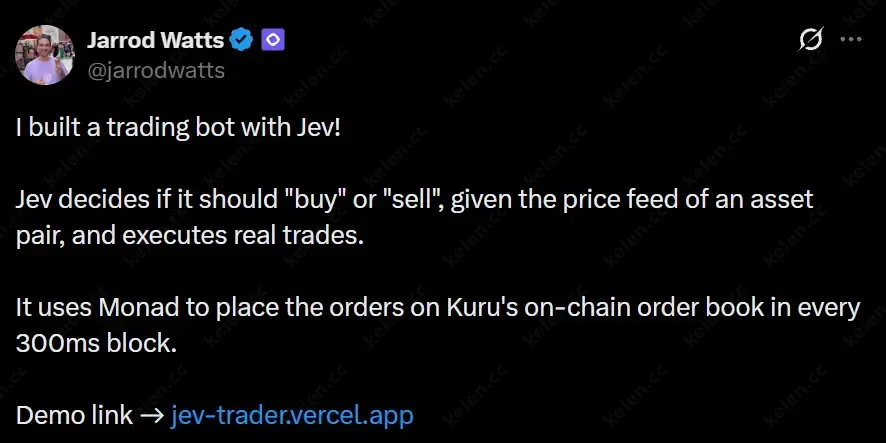
- Real-time trading bot: Jarrod Watts uses Jev to decide whether to buy or sell every 300ms and executes orders on the Monad chain. Related post
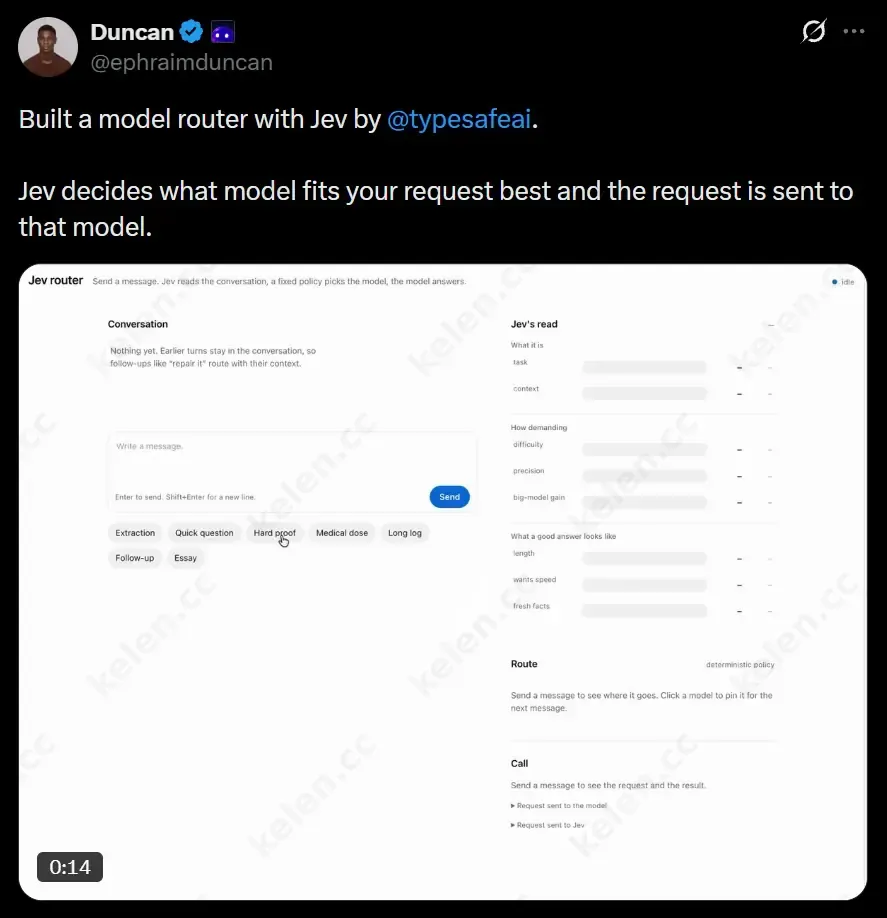
- Model routing: Duncan uses Jev to dynamically select the most appropriate large model based on the request content. Related post
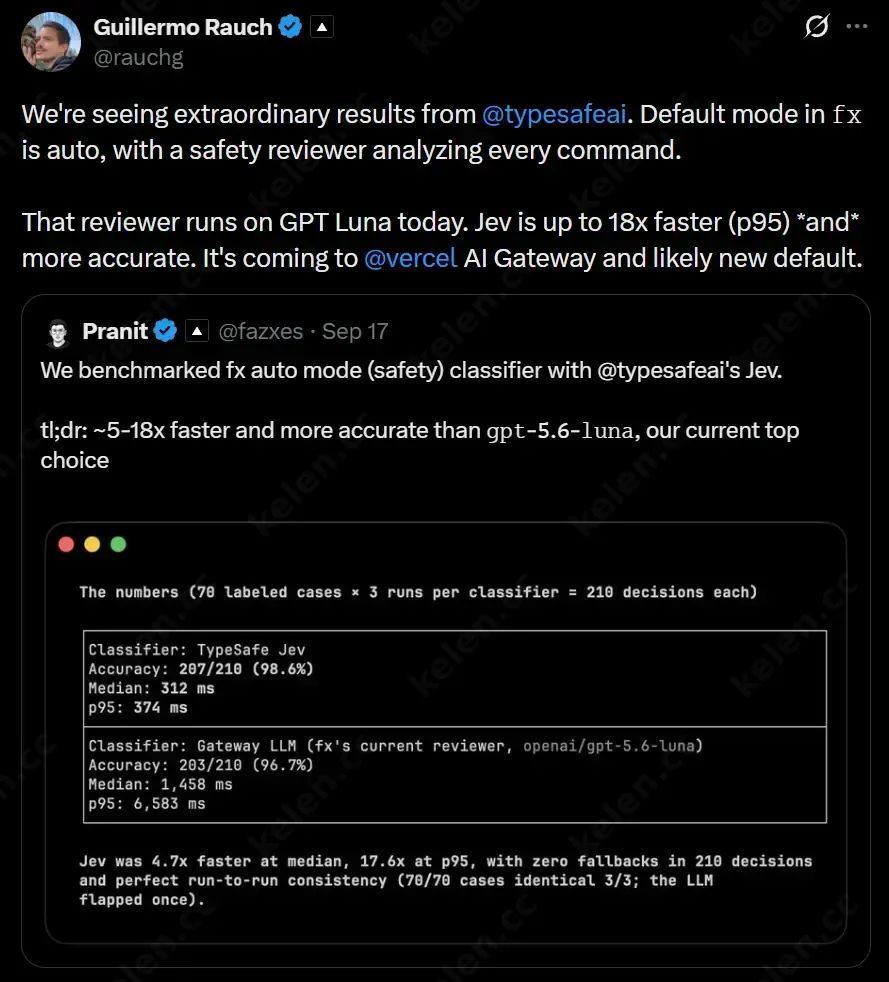
- Security review acceleration: Guillermo Rauch (Vercel CEO) shared that using Jev for security classification in the fx tool is 5–18x faster and more accurate than the previous GPT-based approach. Related post
- Game control: Someone had Jev play Super Mario and Doom, making around 10 decisions per second. Related post

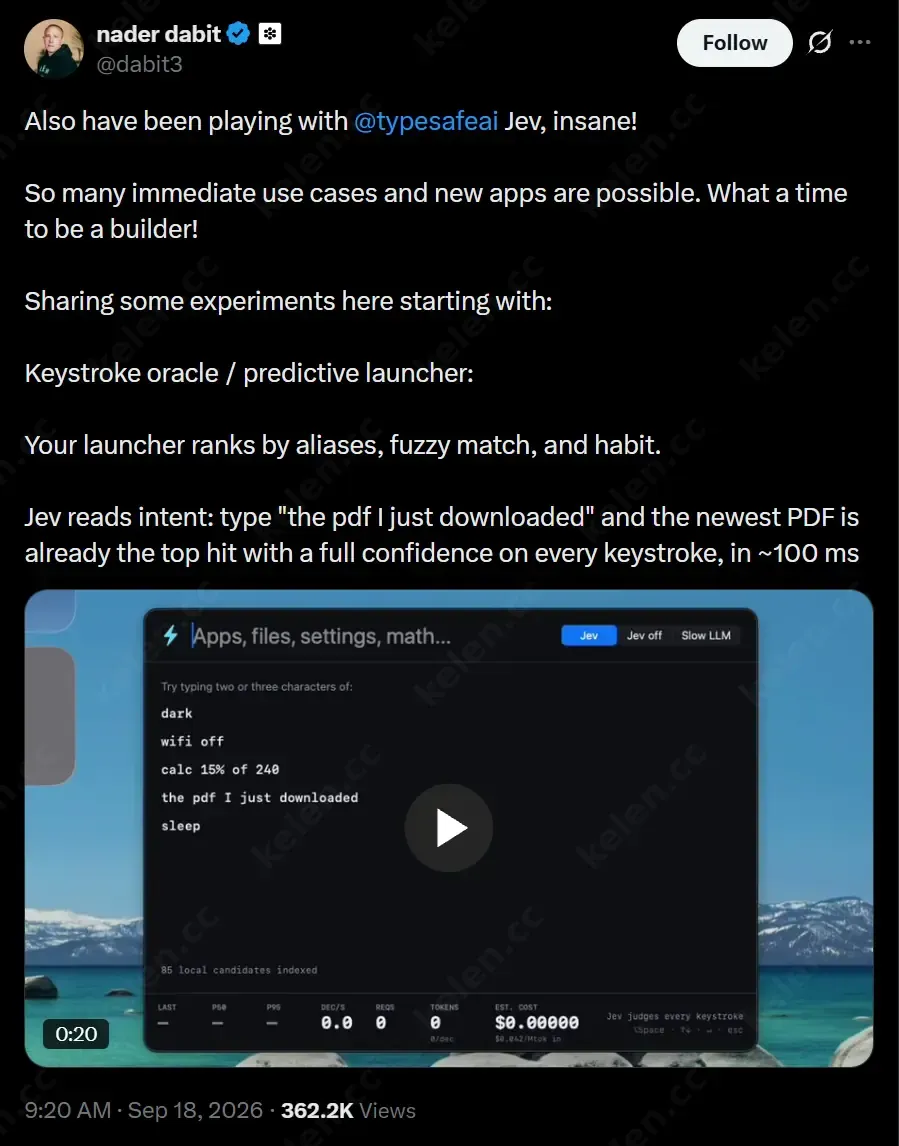
- Keystroke-level intent prediction: nader dabit built a real-time launcher that predicts the file a user wants to open from just a few typed characters. Related post
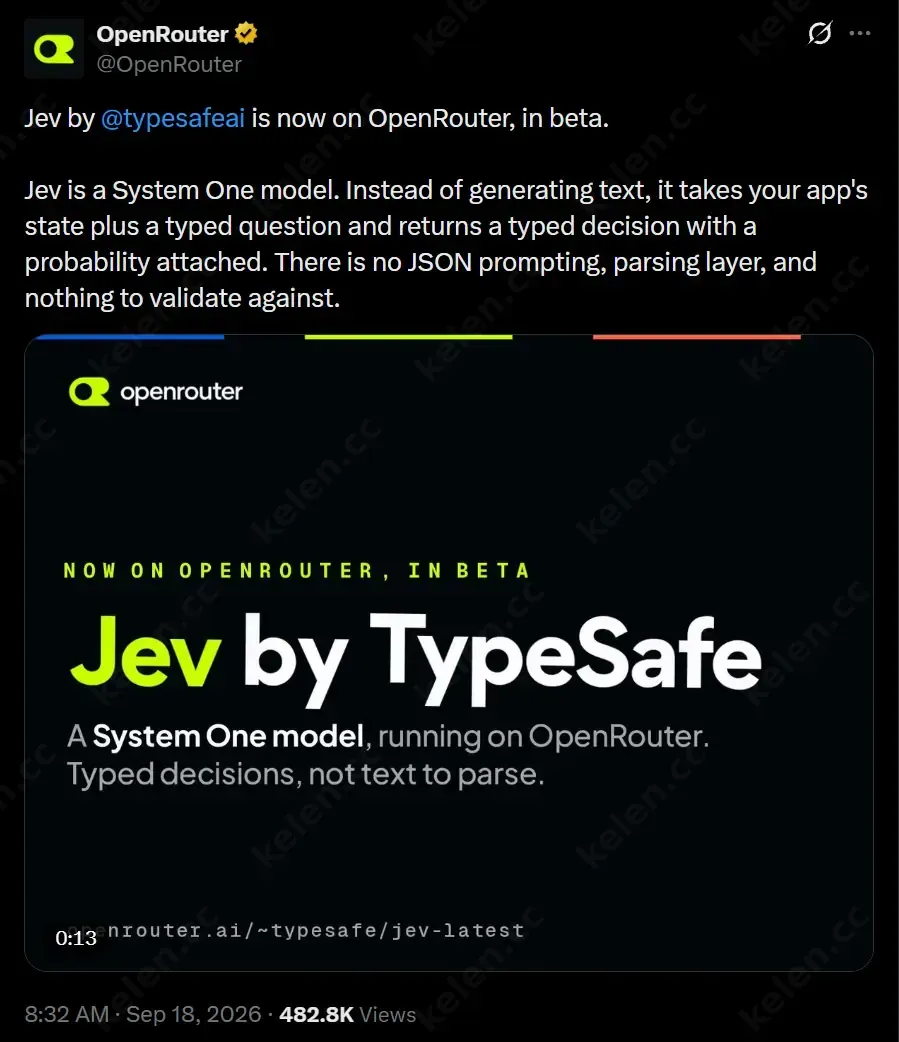
- OpenRouter also officially posted about the integration, emphasizing "no JSON prompting, no parsing layer." Related post
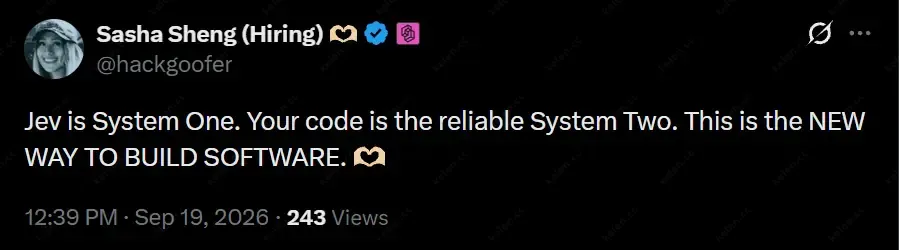
Sasha Sheng (TypeSafe co-founder) summed it up directly:
"Jev is System One. Your code is the reliable System Two. This is the NEW WAY TO BUILD SOFTWARE."
Suitable and Unsuitable Scenarios
Jev is not a replacement for other ChatGPT-class large models, so it still has to be used alongside them. Let's take a look at which scenarios Jev is and isn't suited for.
Very well suited:
- Routing within Agents, tool selection, and deciding whether to continue / retry / escalate to a human
- Content moderation, risk scoring, and ticket dispatch
- Real-time decision-making (trading, gaming, recommendation ranking)
- Scenarios that demand high frequency, low cost, and calibratable confidence
Not suited:
- Generating natural language explanations or creative content
- Deep reasoning over long contexts
- Multimodal input (currently only text/JSON state is supported)
It's more like adding a "reliable intuition system" to your software, rather than replacing existing large models.
How to Get Started?
It's currently in early access, so you need to apply for an API Key from the official site. Official Python and JavaScript SDKs are available, and it's already integrated with the Vercel AI Gateway and OpenRouter.
The basic invocation flow is very clean:
- Pass in
state(your business state) - Define a set of
questions(Choice / Score / Noul) - Receive structured answers with probabilities and branch directly in your code
Conclusion
The emergence of Jev is, at its core, answering a long-overlooked question:
For all the "judgments" software has to make, is it really necessary to have a large model first write out a passage of text and then parse it into JSON?
When decisions themselves become first-class citizens rather than a byproduct of text generation, both the cost and latency of automation will undergo a qualitative shift.
This may not be "the next ChatGPT," but it could well become an indispensable piece of decision-layer infrastructure in future Agent architectures.
If you're building any system that requires high-frequency structured judgment, Jev is worth serious attention right now.